Where can I download PSQL v11?Click
here for downloads.
What are some of the key features of PSQL v11?
PSQL v11 has been optimized for multi-core hardware, enabling your application performance to scale with the latest hardware. PSQL v11 also includes a 64-bit ODBC driver and support for IPv6 - the latest Internet protocol. Some of the key features are:
- Optimized for multi-core hardware
- Helps applications avoid multi-core slowdown
- 64-bit ODBC driver
- Support for IPv6
- Updated ADO.NET data provider
- Updated PDAC
- Telephone Authorization
- Support for the latest releases of AuditMaster, Backup Agent, and DataExchange
What is the latest release of PSQL v11?
The latest release is PSQL v11 SP1.For more details read What's New in Pervasive PSQL v11 SP1
What is new in Pervasive PSQL v11 SP1?PSQL v11 SP1 has updated developer tools, enhanced license administration, performance monitoring and OS support. Below is a short list of the highlights. For more details read
What's New in Pervasive PSQL v11 SP1
- New performance monitor counters to help analyze and tune PSQL applications
- 64-bit support for DTO (including the .NET framework)
- PDAC support for RAD Studio XE
- 64-bit ODBC for Linux
- 32- and 64-bit Support for Red Hat Enterprise 6
- Doubled allowed authorization/deauthorizations to 10
- Added Remaining Authorizations counter
- Added new key state to provide 14 day period to correct licensing issues
- New PSQL Notification Viewer provides easy access to licensing related notices
What platform certifications does Pervasive PSQL v11 have?Pervasive PSQL v11 Certified for Microsoft Windows Server 2008 R2 and is VMware Ready.
Click here for more information.
Why optimize for multi-core hardware?
Any new server hardware purchased today will have a minimum of dual core and most are being sold with quad and eight-way cores. Users with new hardware may notice performance problems with applications that have not been redesigned to take advantage of multi-core processors.
Why do applications slow down on multi-core systems?
Managing multiple cores consumes considerable operating system resources. This problem becomes especially noticeable in applications that have multiple users accessing shared data. Unless the application has been written to run processes in parallel, the overhead of managing multiple cores may cause the application to run more slowly than on the previous hardware. To learn more about why some applications slow down on multi-core hardware read: The Multi-core Dilemma and Multi-core Slowdown.
What has been done to make PSQL v11 run well on multi-core hardware?
PSQL v11 is a parallel implementation of PSQL that includes several enhancements for multi-core:
- Improvements to the low level synchronization mechanisms in the transactional interface
- Multiple users can read the same cached file pages simultaneously and their operations can proceed on multiple cores
- Multiple users accessing independent files can proceed on different cores
- Non-user activity such as checkpoint and log management can also use additional cores
What is the performance improvement of PSQL v11 over PSQL v10?
Pervasive internal testing has shown a typical increase of 50% on 8 core servers, with some customer applications seeing improvements of 400%. As always, results are application specific - so download a copy of PSQL v11 and test your application.
How many cores does PSQL v11 support?
Pervasive has not found an upper limit to the number of cores that PSQL v11 can use. Pervasive has tested PSQL v11 on systems with processors having up to 8 cores. Internal tests showed performance increasing with the number of cores.
Is my application compatible with PSQL v11?Pervasive focuses a great deal of engineering resources to maintain backwards compatibility. PSQL v11 maintains compatibility with file formats from Btrieve 6.15, Pervasive.SQL 2000i, Pervasive.SQL v8,Pervasive PSQL v9, and Pervasive PSQL v10. The fastest way to determine compatibility for your application is to
download and test.
What Operating System Platforms does PSQL v11 support?
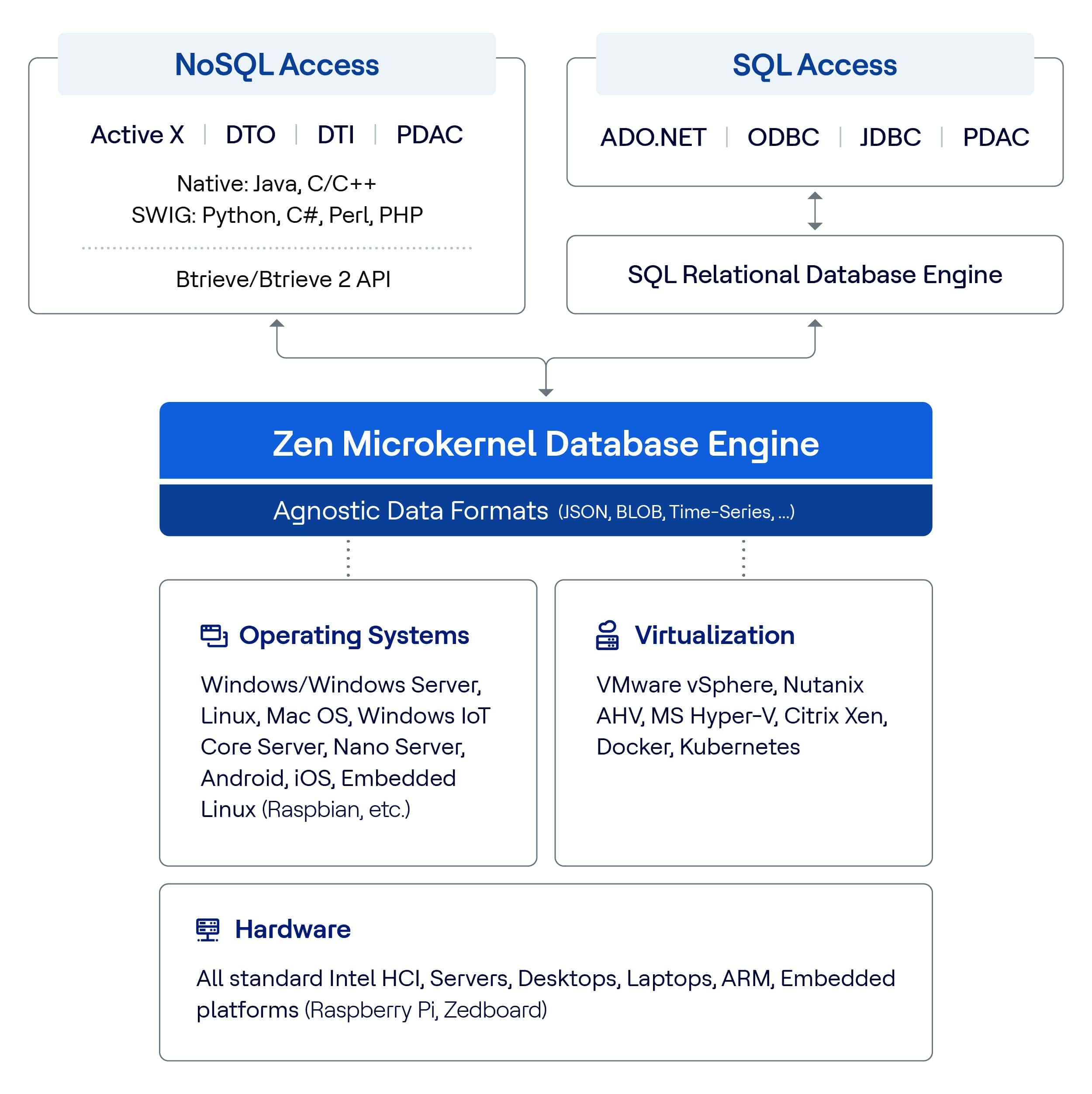
Pervasive PSQL v11 supports current and past versions of Windows including Windows 7, Windows Vista, Windows Server 2008 R2, Windows XP SP3, and Windows 2003. Also supported are Mac OS-X, Red Hat Enterprise Linux 4, 5 and 6 and SUSE Linux Enterprise 10 and 11. For a detailed list of operating systems supported click
here.
What is IPv6 and why is it important?
IPv6 (Internet Protocol version 6) is the Internet protocol that will follow the current version - IPv4. IPv6 support is important because IPv4 has run out of addresses. The last top level block of free IPv4 addresses were assigned in February 2011. IPv6 uses 128-bit addresses (up from 32-bit with IPv4) and can support vastly more than the approximately 4 billion addresses that are nearly used up with IPv4. Anticipating the shift, some governments (for example US and Japan) require that suppliers support IPv6. For more on how to use IPv6 with Pervasive PSQL read
What's New in Pervasive PSQL v11
What support does PSQL v11 provide for virtual machines?
Pervasive PSQL v11 provides support for VM environments from Microsoft, Citrix and VMware. PSQL v11 is VMware ready and Citrix ready.
What is telephone authorization and how does it work?
Telephone Authorization can be used if there is no Internet connection at the machine where PSQL is installed, and the machine is not networked to another machine that is connected to the Internet. A utility is run at the PSQL machine to generate an authorization code. Calling Pervasive (or the OEM who’s application included PSQL) with the authorization code and the key (delivered with PSQL) to authorize the PSQL installation. For more details on Telephone Authorization, read the PSQL v11 User’s Guide.
Will my existing PSQL ecosystem products – Pervasive AuditMaster, Pervasive Backup Agent, and Pervasive DataExchange – work with PSQL v11, or do I need an upgrade?
You need to upgrade to AuditMaster v7, Backup Agent v3 and DataExchange v4. DataExchange 4 now supports both 32- and 64-bit PSQL Server Engines.
What’s new in the PSQL ADO.NET data provider?
PSQL ADO.NET 3.5 for PSQL v11 includes support for the Microsoft .NET Framework Version 3.5 SP1 and 4.0, ADO.NET Entity Framework Version 1.0, and support for Microsoft Visual Studio 2008 and 2010.
What features have been deprecated or discontinued in PSQL v11?
The features discontinued in PSQL v11 are support for: Windows 2000, Delphi and C++ Builder development environments version 6 and older, and Pervasive PSQL ADO.NET Provider versions 2.1 and 3.0. Additional deprecated features (still available in PSQL v11.0 but will be dropped from a future release) include:
- 32-bit engine DSN’s
- DTI functions that manage 32-bit DSN’s
- PDAC dynamic libraries for Delphi 2006 and 2007
How do I report issues with PSQL v11?
All users receive complementary support for 30 days from date of purchase. The Pervasive Support page has more details on our support offerings and policies. Pervasive also offers a free on-line forum called Community Forum where users can post questions and share feedback with the community of Pervasive developers, partners, and users. You will also see comments, tips, and support from the Pervasive Engineering and Support organizations. Visit our forum for assistance.
How much longer will Pervasive PSQL v10 be supported and available?Pervasive offers a published
Product Support Lifecycle guide for all PSQL products. Pervasive PSQL v10 will enter transition support on September 1, 2011 with end of support on March 1, 2012. Please
review the guide for more details.
What file formats are supported?
Pervasive PSQL v11 offers full support for 6.x, 7.x, 8.x and the 9.x file format. Versions 5.x and prior cannot be modified.
Do I have to rebuild all my files to be compatible with Pervasive PSQL v11?
No, if you are using file versions 6.x, 7.x, 8.x, or 9.x you do not need to rebuild your files to be compatible with PSQL v11.
Can I use my existing license counts from previous versions of PSQL?No. Previous version license keys are not compatible with Pervasive PSQL v11. PSQL v11 licenses are by Operating System (Windows or Linux) and platform type (x86 or x64). As with prior release of Pervasive PSQL, upgrade licenses can be purchased. For more information contact your nearest
Pervasive Partner or
contact Pervasive.